.png)


The Hidden Landscape of the Hepste Valley

The landscape surrounding the Afon Hepste and Llyn Fawr is one of the most remarkable corners of Bannau Brycheiniog. Here, rivers disappear underground, water re-emerges from hidden limestone passages, waterfalls plunge into deep gorges, and Bronze Age cairns overlook the surrounding hills.
At first glance these features may seem unrelated. Yet when viewed together they reveal a landscape that may have held special significance for prehistoric communities thousands of years ago.

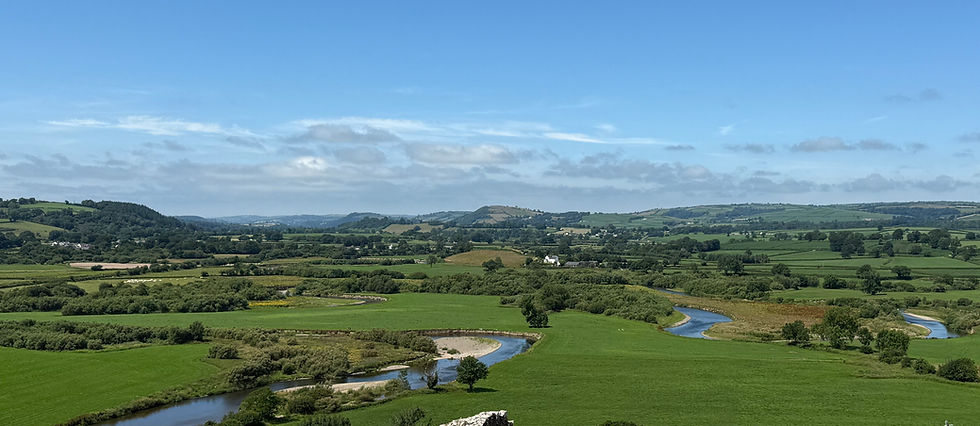
Moel Penderyn overlooking the Hepste Valley
A Landscape Shaped by Water
The Hepste Valley is one of the finest examples of karst landscape in southern Wales.
Beneath the upland plateau lie limestone formations through which water can travel underground. As rivers cross the limestone, some of their flow disappears into swallow holes before re-emerging elsewhere through springs.
One of the most intriguing examples is a spring known locally as the Ubbly Bubbly, where groundwater rises through the riverbed and creates visible bubbling currents on the water's surface. Nearby, Sgwd yr Eira and the other waterfalls of Waterfall Country add to the sense that this is a landscape where water is constantly crossing between visible and hidden worlds.

Scwd yr Eira Waterfall in the Hepste valley
The Bronze Age Cairns Above the Valley
Above the gorge, the uplands around Penderyn contain numerous Bronze Age cairns. These stone burial monuments occupy ridges and watersheds overlooking the surrounding valleys. From these locations prehistoric communities could look across the Hepste Valley, the Cynon Valley, and the wider mountains of Bannau Brycheiniog.
My research found that these cairns occur significantly closer to the watershed than would be expected by chance. Rather than being randomly scattered across the landscape, their placement appears to have been influenced by the structure of the terrain itself.

Cairn above the Hepste valley
The Mystery of Llyn Fawr
A few kilometres west of the Hepste Valley lies Llyn Fawr, a mountain lake beneath Fan Brycheiniog. Today it appears peaceful and remote, but in the early twentieth century it produced one of the most important archaeological discoveries ever made in Wales.
When water levels were lowered, archaeologists uncovered a remarkable collection of bronze axes, spearheads, tools, horse harness fittings, and an early iron sword. The discovery was so significant that archaeologists named an entire phase of British prehistory after it: the Llyn Fawr Phase.
What makes the hoard particularly fascinating is that these objects were not buried in a settlement or grave. Instead, they had been deliberately placed within the waters of the lake itself. Similar deposits are known across prehistoric Europe and are often interpreted as ritual offerings made to important water bodies.
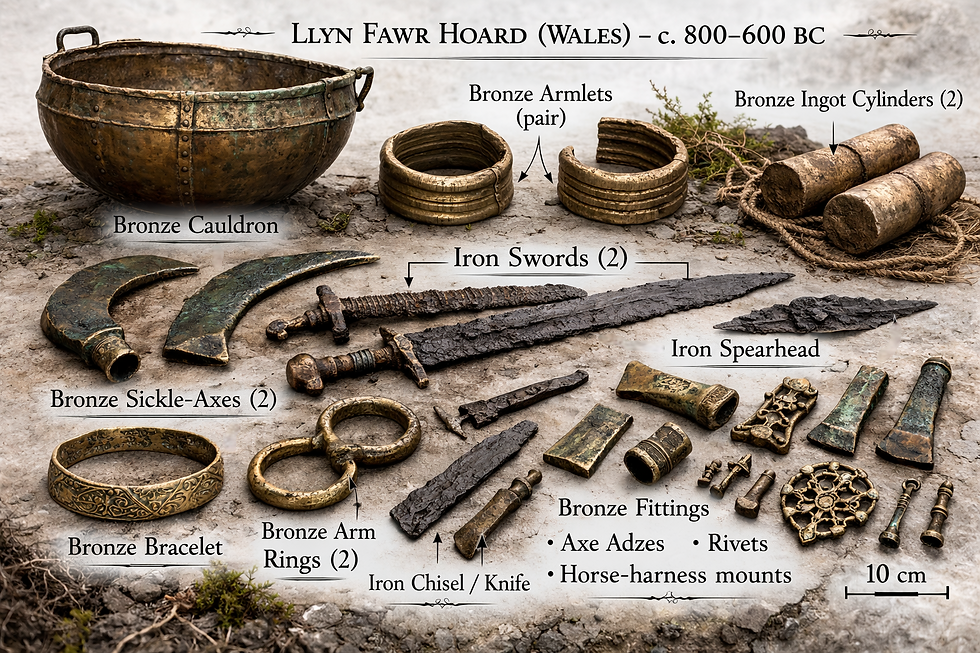
Reconstruction of the llyn fawr hoard
A Prehistoric Threshold Landscape?
One of the most intriguing aspects of the Hepste landscape is the way so many natural boundaries converge within a relatively small area. Watersheds divide river systems. Rivers disappear underground before returning to the surface. Waterfalls mark geological transitions. Cairns stand upon ridge-top divides, while nearby lakes received valuable ritual offerings.
Archaeologists sometimes describe such places as liminal landscapes — landscapes of transition and thresholds. While we cannot know exactly how Bronze Age communities understood these places, the combination of unusual hydrology, prominent monuments, and ritual deposition suggests that this landscape may have carried meanings beyond its practical value.
Conclusion
The Hepste Valley is often celebrated for its waterfalls and walking routes, yet its significance may run much deeper. This landscape combines extraordinary geology, unique hydrology, and evidence of prehistoric activity stretching back thousands of years.
The cairns on the uplands, the disappearing rivers in the gorge, and the treasures hidden beneath the waters of Llyn Fawr all hint at a landscape that may once have occupied a special place within the prehistoric world of southern Wales.
For visitors today, it remains one of the most fascinating places in Bannau Brycheiniog—a landscape where geology, archaeology, and history meet in remarkable ways.


Comments